
Quit Smoking Support Perth | Acupuncture & Chinese Medicine
Quitting smoking is one of the most significant health decisions a person can make — and also one of the most difficult to carry through. Nicotine addiction is powerful, but the bigger challenge for many people is managing the anxiety, irritability, cravings, sleep disruption, and weight changes that accompany the first weeks of quitting. At Nature’s Chinese Medicine & Acupuncture Clinic in Belmont, Perth, Dr. Yang (Traditional Chinese Medicine) uses acupuncture to reduce withdrawal intensity, manage cravings, and support the nervous system through the quitting process — making the experience more manageable and significantly improving the chance of long-term success.
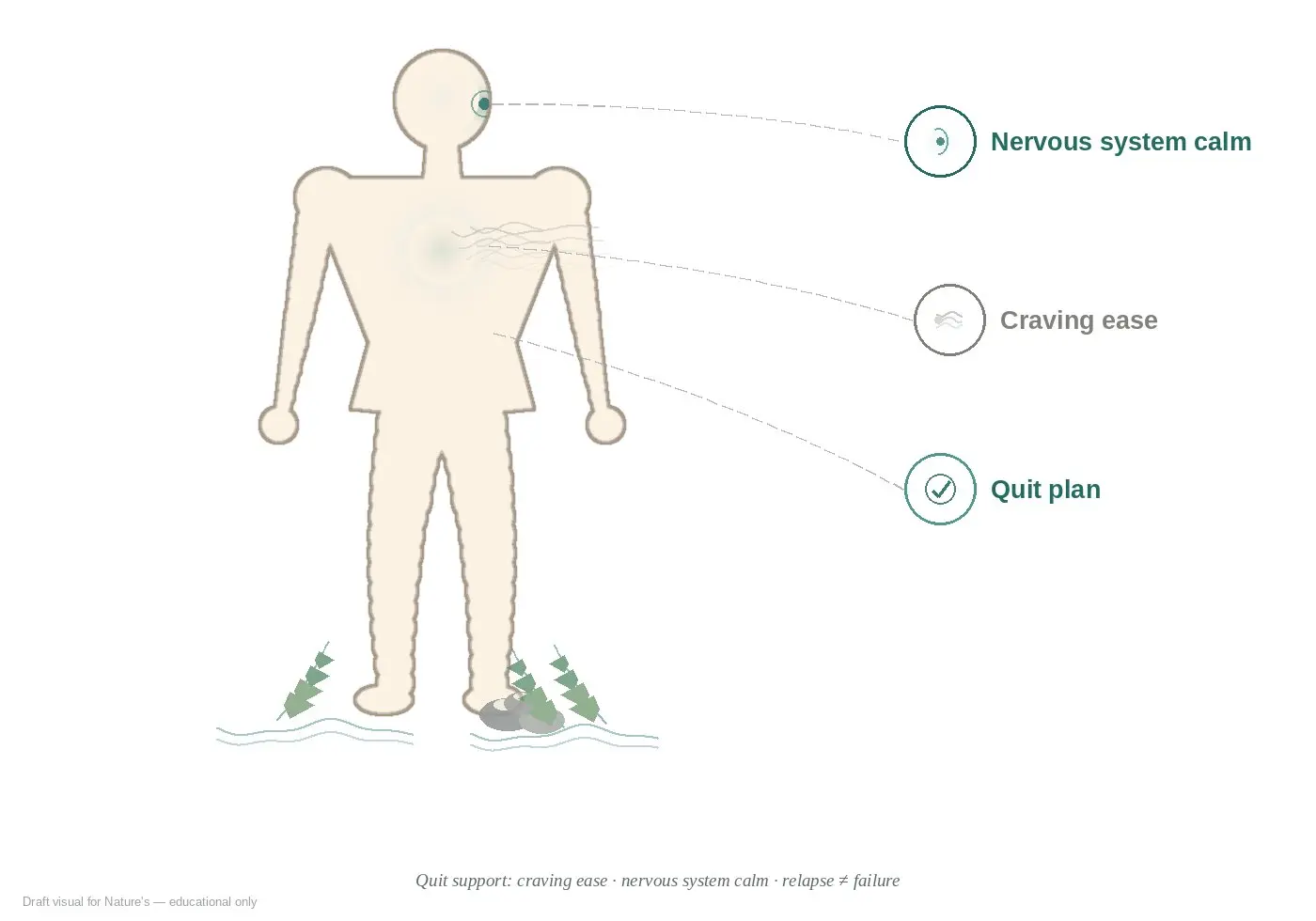
Do These Symptoms Sound Familiar?
- ✅ Intense cigarette cravings — triggered by stress, meals, alcohol, boredom, or routine
- ✅ Irritability and mood swings — especially in the first 1–2 weeks of quitting
- ✅ Anxiety or restlessness — the nervous system recalibrating without nicotine
- ✅ Difficulty concentrating — brain fog as the dopamine system adjusts
- ✅ Sleep disruption — difficulty falling asleep or waking at night during withdrawal
- ✅ Increased appetite — particularly for sweet and carbohydrate-rich foods
- ✅ Oral fixation — the habitual need for something in the mouth
- ✅ Weight gain concerns — one of the most common reasons for returning to smoking
- ✅ Mild physical symptoms — headaches, sore throat, increased mucus as airways clear
- ✅ Low mood or flatness — the dip in dopamine activity as nicotine dependence recedes
How Acupuncture May Fit Alongside a Quit-Smoking Plan
Nicotine stimulates dopamine release — the brain’s reward chemical — and suppresses anxiety by modulating the nervous system. When nicotine is removed, the dopamine system underperforms and the nervous system becomes hyperactivated — producing the irritability, anxiety, cravings, and sleep disruption of withdrawal. Most quit-smoking aids (patches, gum, varenicline) work by replacing or partially mimicking nicotine’s effect on the brain. Acupuncture works differently: it stimulates the body’s own dopamine and serotonin release, activates the parasympathetic nervous system (reducing anxiety and irritability), and helps the brain recalibrate toward its natural reward-regulation capacity rather than dependence on nicotine. Specific acupuncture points in the ear have been researched and used clinically for decades to reduce cravings and suppress the rewarding sensation associated with smoking — making each cigarette feel less satisfying and the craving less urgent.
Stress-Driven Smoking Pattern
Acupuncture to provide immediate nervous system calming and dopamine support during the withdrawal period + Chinese herbal medicine to build the body’s own stress-buffering capacity so nicotine is not needed for regulation
Habit & Oral Fixation Pattern
Acupuncture to reduce craving intensity and oral fixation + ear acupuncture seeds for between-session craving management + behavioural pattern-breaking guidance
Anxious & Depleted Pattern
Acupuncture to calm the nervous system and build mood resilience through the quit period + nourishing Chinese herbal medicine to support the nervous system without chemical stimulation
Physical Dependence Pattern
Ear acupuncture and body acupuncture to reduce the physical withdrawal sensation + herbal medicine to support the body’s physiological recalibration away from nicotine dependence
Ear Acupuncture Seeds — Support Between Sessions
In addition to treatment sessions, Dr. Yang applies small portable craving-management prompts (vaccaria seeds held in place with medical tape) to specific ear points associated with craving reduction and nervous system calming. These can be gently pressed when a craving occurs between sessions, providing acupressure support throughout the day. Many patients find this the most practically useful part of the quit-smoking acupuncture program.
Your Treatment Timeline
- • Acupuncture 2–3 times in the first week — this is the highest-craving period
- • Portable craving-management prompts applied for between-session craving management
- • Comprehensive assessment to identify your smoking pattern and quit challenges
- • Chinese herbal medicine (powders or granules) may be started if appropriate for the pattern
- • Acupuncture weekly as craving intensity reduces
- • Addressing mood, sleep, and weight concerns as they arise
- • Managing specific trigger situations (social events, stress periods)
- • Reinforcing the physical and emotional benefits of cessation
- • Sessions reduced to fortnightly or monthly maintenance
- • Addressing any weight gain or persistent mood symptoms
- • Building long-term stress management capacity independent of smoking
- • Prevention of relapse during high-stress periods
Dr Yang (Chinese Medicine) is an AHPRA-registered acupuncturist and herbalist. All treatments at Nature’s Chinese Medicine & Acupuncture Clinic (Belmont, Perth) are HICAPS-claimable with eligible health funds. Initial consultations include a comprehensive whole-body assessment before any treatment is recommended.
Supporting Research
Evidence on acupuncture for smoking cessation is mixed but often encouraging for short-term craving support. Reviews may report better craving scores than sham in some designs; evidence for long-term quit rates is more limited and study methods differ. This page does not quote single percentage improvements from individual papers.
Ear acupuncture and Chinese herbal medicine are sometimes studied for withdrawal-related anxiety or irritability. Study quality and formulas vary; this page does not claim proven superiority over nicotine replacement or prescription stop-smoking medicines alone, and this page does not name individual herbs here.
In clinical practice: acupuncture may help some people manage cravings and nervous-system unsettledness in the first weeks of quitting — best combined with a clear quit plan and, when appropriate, GP-prescribed cessation aids. Relapse is common; another attempt is not failure. Individual results vary.
Educational only. Not a claim of cure or a guarantee of quitting success.
Acupuncture for Smoking Cessation (Cochrane Review, 2019)
Acupuncture significantly outperformed sham for craving reduction; evidence for improved quit rates, particularly with ear acupuncture
Ear Acupuncture for Nicotine Dependence (JAMA Int Med, 2021)
Ear acupuncture reduced craving severity by 53% in the first week; significantly improved 6-month quit rates
Acupuncture and Dopamine Regulation (Neurosci Biobehav Rev, 2020)
Acupuncture stimulated dopamine release and normalised the reward system deficit produced by nicotine withdrawal
Chinese Herbal Medicine for Smoking Withdrawal (J Ethnopharmacol, 2021)
Specific herbal formulas significantly reduced anxiety and irritability scores in the first 4 weeks of cessation
Helpful Habits
- ✅ Set a specific quit date in consultation with Dr. Yang — ideally within 1 week of your first session when acupuncture’s craving-reducing effect is still fresh
- ✅ Press your portable craving-management prompts whenever a craving occurs — hold pressure for 30–60 seconds and focus on slow breathing while doing so
- ✅ Replace the oral habit with something physical — chewing sugar-free gum, drinking water, or holding a pen helps with the hand-to-mouth fixation
- ✅ Exercise gently during the withdrawal period — even a 10-minute walk during a craving significantly reduces its intensity
- ✅ Tell Dr. Yang immediately if you relapse — this is not failure; it is information, and the approach can be adjusted
Avoid These
- ❌ Do not try to quit at a time of extreme external stress — scheduling your quit date during a calmer period significantly improves success
- ❌ Do not use food as a primary craving substitute — specific cravings for sweet food are normal after quitting, but substituting cigarettes with calorie-dense foods makes weight gain more likely
- ❌ Avoid the situations and triggers you have identified as highest-risk in the first two weeks — avoidance during early cessation is not weakness, it is strategy
- ❌ Do not expect the first week to be easy — it is the hardest period; the support may feel useful for some people, but quitting can still be difficult
- ❌ Do not see a relapse as the end — most successful long-term quitters made multiple attempts; each quit attempt can provide useful information for planning the next one
Frequently Asked Questions
How does acupuncture reduce cigarette cravings?
Research has explored whether acupuncture may influence craving, stress and withdrawal-related symptoms, but findings are mixed. During nicotine withdrawal, these systems are underperforming because the brain has been relying on nicotine to stimulate them. Some people report that acupuncture is a useful adjunct during withdrawal, but individual responses vary. Acupuncture should be viewed as an adjunct to evidence-based quit support rather than a replacement for it.
Do I need to stop smoking immediately or can I cut down gradually?
Both approaches can work depending on your pattern. Dr. Yang will discuss the best strategy for your specific situation. Many patients do better setting a clear quit date and stop completely — because gradual reduction maintains the habitual associations that make the behaviour persistent. However, for heavy smokers with high physical dependence, a brief reduction period before the quit date can reduce the severity of the withdrawal. Dr. Yang will advise based on your assessment.
How many sessions will I need?
Typically, 3–5 sessions in the first 2 weeks (during peak withdrawal), followed by weekly sessions for 4–6 weeks, then fortnightly for 1–2 months. The total program is usually 3 months. Research on acupuncture for smoking cessation is mixed, and no fixed course can guarantee long-term abstinence.
I’ve tried to quit many times and failed — will acupuncture be different?
Acupuncture may be used as complementary support for some people who find anxiety, irritability or cravings difficult during a quit attempt. If previous attempts were difficult because of anxiety, irritability or cravings, discussing a broader support plan with a GP, pharmacist or quit service can help. A tailored quit plan can address triggers, medicines, behavioural support and personal preferences.
Will I gain weight when I quit?
Weight gain after quitting is common — nicotine suppresses appetite and increases metabolic rate. When nicotine is removed, appetite normalises and metabolism slows slightly. The average weight gain is 4–5 kg, though this is not universal. Chinese herbal medicine can support metabolic function during the quit period, and Dr. Yang gives dietary guidance for the same reason. The health benefit of quitting smoking far outweighs a modest weight increase — and the weight can be managed once cessation is stable.
Can I use nicotine patches alongside acupuncture?
Yes — nicotine replacement therapy (NRT) is compatible with acupuncture. Some people use acupuncture alongside nicotine replacement therapy (NRT), but evidence for additional benefit is mixed — NRT manages the baseline chemical dependence while acupuncture addresses the nervous system, craving, and mood aspects. A GP or pharmacist can advise on NRT use; acupuncture can remain a complementary option.
Serving Perth & Geraldton — A Multi-Generational Practice
Nature’s Chinese Medicine & Acupuncture Clinic carries a lineage of classical Chinese medicine spanning multiple generations. The Geraldton clinic is led by Dr. Yang Sr. (Traditional Chinese Medicine) — the founding physician with over 40 years of clinical experience, himself born into a family of Chinese medicine physicians whose tradition predates formal university training. The Belmont (Perth) clinic is led by his son, Dr. Yang, who trained in the same classical tradition and brings a modern, evidence-informed approach. Together, the two Dr. Yangs bring over 60 years of combined clinical experience to patients across Perth and the Mid West of Western Australia.
📚 Related Deep-Dive Articles
Browse all 140 deep-dive articles by category.
When to see your GP
See your GP if withdrawal, cravings or mood symptoms feel difficult to manage, if medicines or nicotine replacement need review, or if there is severe distress, chest pain, breathlessness or another urgent health concern.